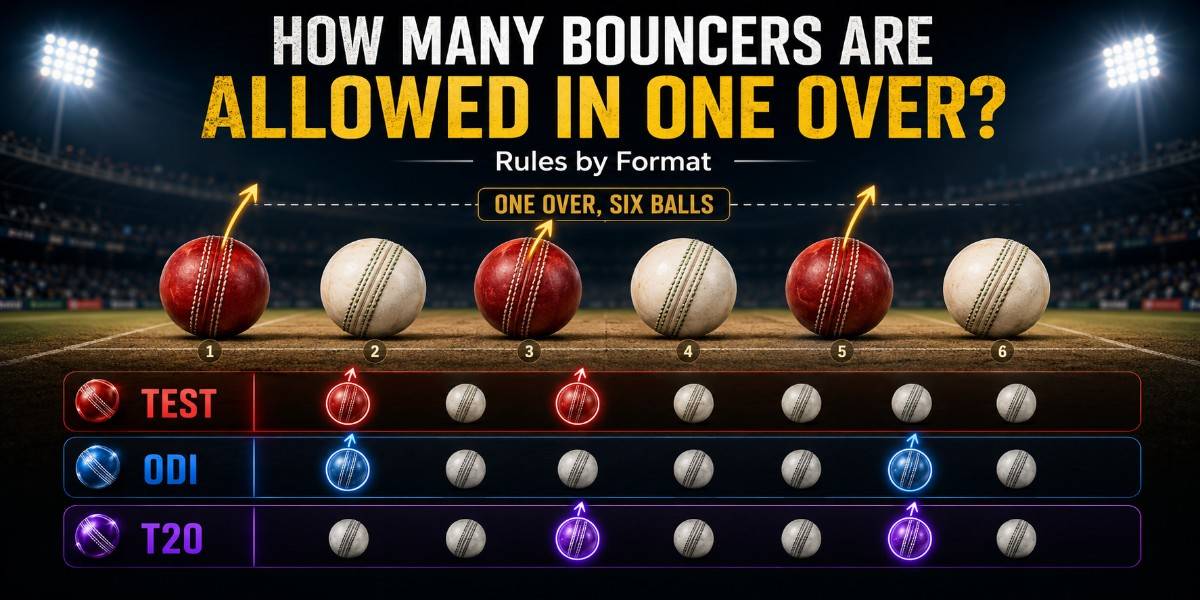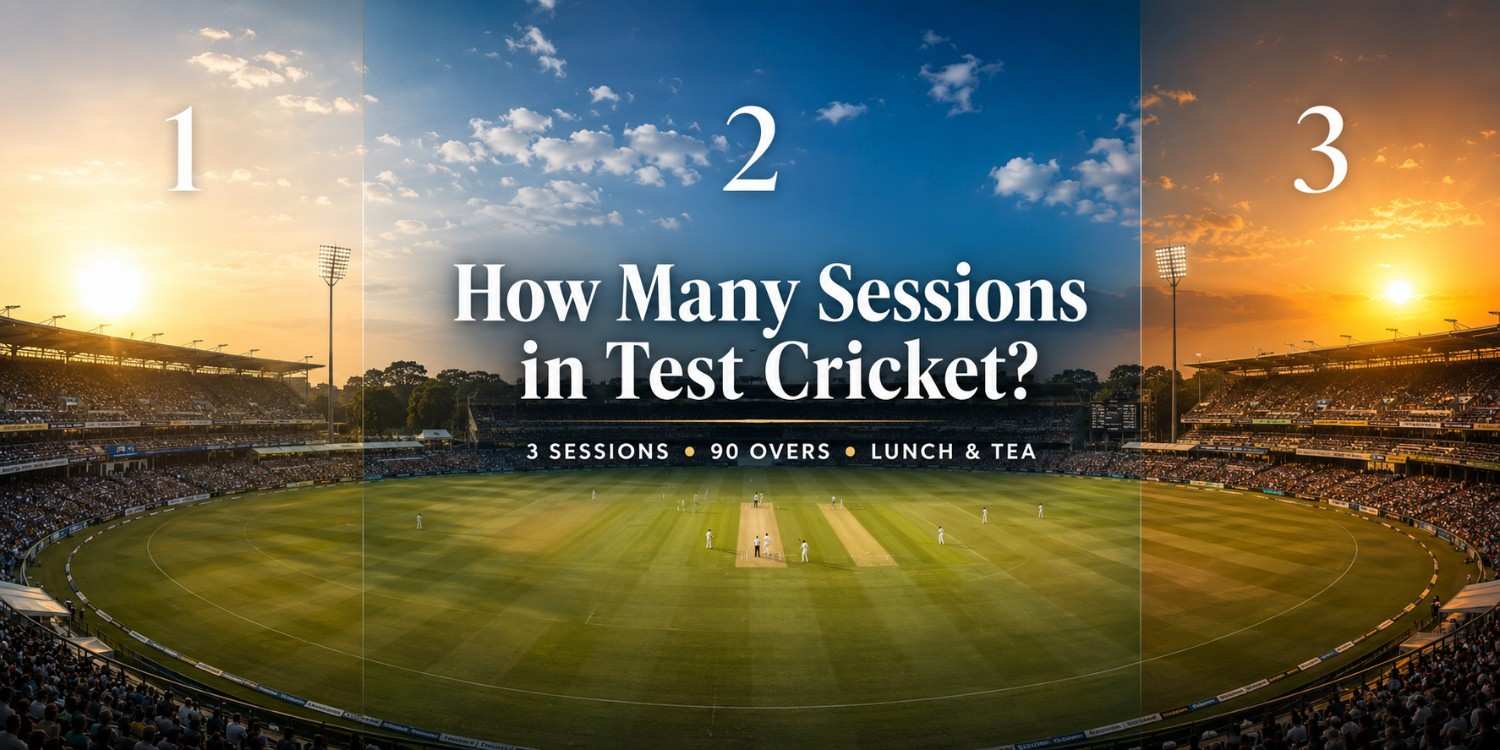
Test cricket divides a full scheduled day into three sessions. Therefore, the answer to how many sessions in Test cricket is three per day, producing as many as 15 scheduled sessions across a five-day match. A contest can end much earlier, however, because play concludes as soon as either team secures a result.
The three periods are formally described as the first, second and third sessions. In a conventional daytime Test, they are also called the morning, afternoon and evening sessions. Their scheduled boundaries may change when rain, fading light, an innings change or permitted extra time affects the day’s programme.
Test Cricket Format Explained: How Sessions Divide the Contest
A session is a continuous block of play between the start or resumption of the game and the next major interval. The applicable test match rules and regulations determine the playing hours, intervals and permitted adjustments. Within the broader 5 day test match rules, four principles explain how the sessions fit into the contest:
- A standard Test is scheduled for a maximum of five days.
- Each side can bat twice, allowing as many as four innings.
- The match ends once a result has been secured.
- If the available playing time expires without a result, the match ends in a draw.
How Do the Three Test Match Sessions Per Day Unfold?
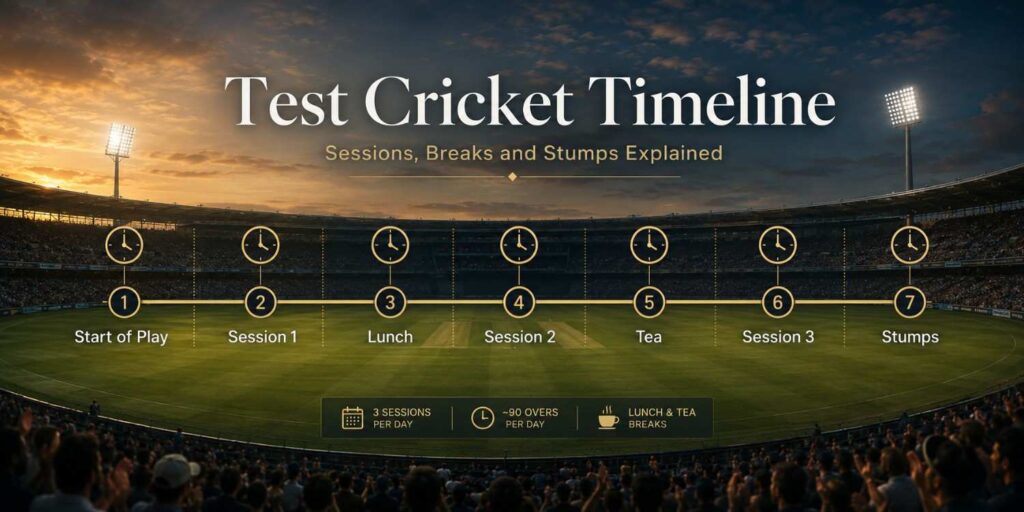
A Test day follows a clear order. Play begins or resumes in the first session, continues through the second and reaches the scheduled close during the third. Local hours vary between venues, but the sequence remains unchanged. Day-night Tests follow the same three-part framework, which makes first, second and third the most reliable session labels.
| Session | Place in the day | Cricketing context | What follows |
| First | Opening period | Start or overnight resumption | First main interval |
| Second | Middle period | Play between the two main intervals | Second main interval |
| Third | Closing period | Final phase of the scheduled day | Stumps or close of play |
Stumps normally closes the day rather than the entire match. If an interval time arrives during an over, the over is generally completed first. However, a dismissal or retirement within the final three minutes may bring the interval forward. An innings change, adverse weather, fading light, the nine-wickets-down provision or authorised extra time may also adjust the schedule. The published match programme confirms the local playing hours.
How Many Overs Are Bowled in a Test Cricket Session?
There is no fixed allocation for test cricket overs per session. Thirty overs is simply a convenient estimate based on dividing the standard 90-over target for a non-final day in men’s Test cricket across three sessions. As per the rules of the format, session timings and the applicable playing conditions determine the actual total.
| Common claim | Verdict | What the rule means |
| Every session contains 30 overs | Incorrect | Thirty is an approximate share |
| A session can contain fewer overs | Correct | Delays and slower play reduce the count |
| A session can contain additional overs | Correct | Faster play or an extension can raise the total |
| The third session has the most overs | Not guaranteed | Its length and pace may vary |
Reviews, wickets, injuries, interruptions and innings changes take time from play. By contrast, faster over rates and fewer stoppages can increase the number completed. Thirty remains a useful estimate, but it is neither a compulsory target nor a session limit.
Do Men’s and Women’s Tests Use the Same Daily Over Target?
The current playing conditions set separate minimum over rates for men’s and women’s Tests. Men’s cricket uses 15 overs per hour, giving 90 overs across six scheduled hours on a non-final day. Women’s cricket uses 16.67 overs per hour, producing a 100-over target across the same period.
| Test format | Scheduled play | Non-final-day target |
| Men’s, June 2025 conditions | 6 hours | 90 overs |
| Women’s, July 2026 conditions | 6 hours | 100 overs |
These figures answer the broader question of overs in a test match per day, but they cannot be divided into compulsory session totals. A session has no independent over quota. Lost time, an innings change and the relevant adjustment rules determine how the daily requirement changes.
This comparison is accurate as of August 2026 and should retain that date because later conditions may revise either calculation.
How Long Does a Test Match Session Last?
The scheduled length
The rules provide six scheduled playing hours, and the day contains three sessions. Two hours per session follows as a convenient average. For test cricket session time, it is a useful planning figure rather than an exact statutory duration.
What happens on the field
Session boundaries respond to defined match situations. An over that has already begun is generally completed before the interval. If nine wickets are down near lunch or tea, play may continue under the applicable extension provision. An innings ending near a scheduled break can also change when the interval begins.
Rain, unsuitable light and other interruptions reduce the time available. Rescheduling, make-up time and permitted extensions may redistribute play across the remaining sessions.
What Is the Test Match Lunch Break Time?
Lunch and tea
The standard arrangement provides 40 minutes for lunch and 20 minutes for tea. Lunch follows the first session in a conventional daytime schedule, with tea separating the second and third.
A different division requires visiting Board consent and ICC approval following a request from the Home Board. The combined scheduled duration must still equal 60 minutes.
Drinks breaks
The midpoint of each session is the scheduled position for a drinks interval. Each break must be brief and cannot continue beyond four minutes. Umpires can allow extra drinks when extreme heat requires them.
Captains may agree to forgo drinks intervals, provided the umpires are informed. Scheduled drinks are excluded from the final hour.
The interval between innings
Ten minutes normally separate the end of one innings from the start of the next. If the innings closes near lunch or tea, this period may be included within that scheduled break. No additional session is created.
How Do Test Cricket Overtime Rules Work?
The test cricket over time rules operate as a sequence of decisions. The umpires first establish the applicable minimum, then determine whether extra time is required, recoverable or safe.
- Has the daily target been reached?
On a non-final day in a men’s Test, play is scheduled to continue until 90 overs or the agreed closing time, whichever comes later. A revised minimum applies if playing time has been lost. - Has the closing time arrived first?
If required overs remain, permitted overtime begins. The maximum test cricket over time limit is 30 minutes beyond the scheduled or rescheduled close. - What happens when 30 minutes expire?
Play ends after the over in progress. Any remaining overs from the daily minimum are not transferred to the next day. - Was playing time lost earlier?
A qualifying suspension may be recovered on the same day, subject to weather and light, for up to one hour in total. Unrecovered time can be added to later days at a maximum of 30 minutes per day. - Can the match finish shortly?
A captain may request extra play. If the umpires agree that a definite result can be achieved, they may allow up to 30 minutes at the end of a non-final day or 15 minutes at lunch or tea. - Can the time still be recovered?
If recovery is unavailable, the minimum over requirement is recalculated under the relevant formula.
The sequence stops immediately if a result is reached. Play also cannot continue when the umpires judge the ground, weather, light or other circumstances to be dangerous or unreasonable.
Why Can Lunch, Tea or Session Times Move?
The agreed schedule provides the starting point. The state of play then determines whether an adjustment is required:
- Lunch may begin early when an innings or stoppage occurs close to the interval.
- Tea can move forward under similar innings-end or interruption provisions.
- Nine wickets down near lunch or tea may keep the teams on the field longer.
- Lost time and subsequent recovery can alter the day’s timetable.
- Daylight patterns at the venue can influence the original interval order.
The India–South Africa Test at Guwahati in November 2025 was scheduled around an early winter sunset. Play ran from 9:00 am to 4:00 pm. Tea was taken first, from 11:00 to 11:20 am, and lunch followed from 1:20 to 2:00 pm. The arrangement preserved six hours of scheduled play before the light deteriorated.
What Changes in a Day-Night Test?
Day-night Test sessions follow the same three-stage order as a daytime Test. Their position on the clock changes, and the third session is played under artificial lighting.
Tea may come after the first session, followed by a longer dinner interval after the second. This is a scheduling choice rather than a universal formula. The boards agree the local day-night test match timings for the fixture, subject to six scheduled playing hours and the relevant approval. The official programme supplies the exact start, intervals and close.
In Summary
A Test is arranged around three sessions per day, although the published schedule and the cricket played on the field do not always align perfectly. Therefore, anyone asking how many sessions in Test cricket should use three as the daily answer and consult the official programme for the exact local timings.
FAQs
Does a change of innings create another Test session?
No, an innings change brings a ten-minute interval, but the day still retains its standard three-session framework. Play resumes within the existing schedule unless the change coincides with lunch, tea or stumps.
Can a Test day finish before the third session?
Yes, a completed result, abandonment, dangerous conditions or the loss of all remaining playing time can end the day before the third session begins or before its scheduled finishing point arrives.
What does “winning a session” mean in Test cricket?
It describes the team that gained the stronger position during that passage through runs, wickets or control. The phrase has no official scoring value and does not determine the eventual match result.
How many sessions are scheduled in a four-day Test?
A four-day Test allows up to 12 scheduled sessions under the standard three-per-day structure. Fewer may be played when a result is secured early or interruptions remove the remaining playing time.
Does lunch or tea count as Test match playing time?
No, lunch and tea fall outside the six scheduled hours of active play. Together they occupy 60 minutes in the standard timetable, although approved arrangements can divide that hour differently.