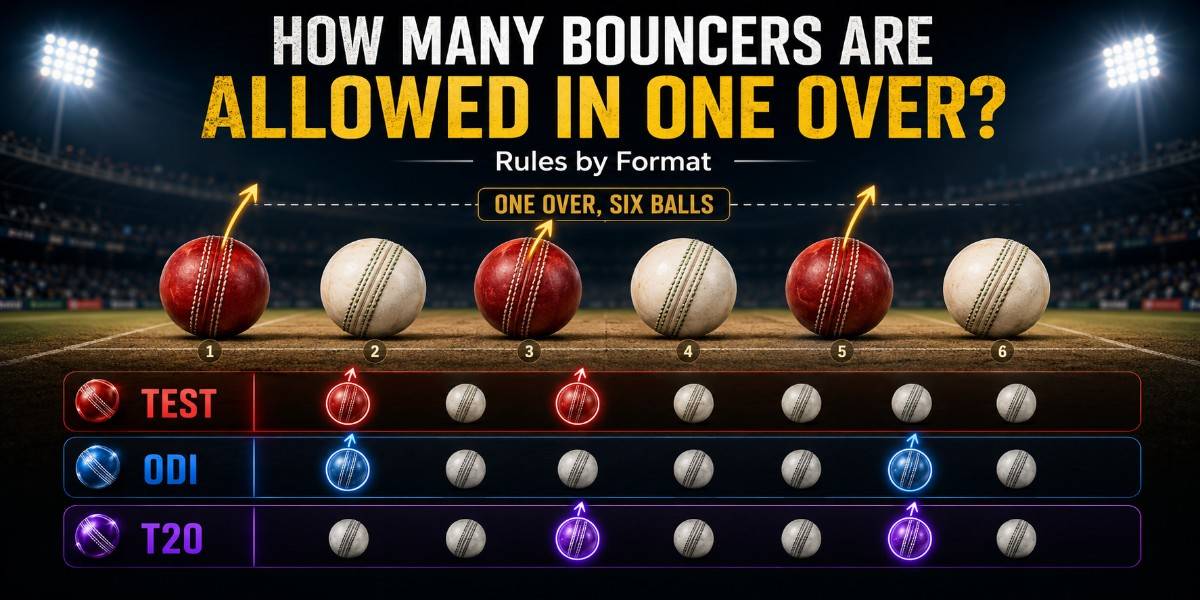
The answer to how many bouncers are allowed in one over depends on the match format and the playing conditions in force. In ICC men’s Tests and ODIs, a bowler can deliver two fast short-pitched balls in one over. In ICC men’s T20Is, the limit is one. In IPL 2026, the playing conditions allow two.
A bouncer is not judged by crowd reaction or batter discomfort alone. The official test is height. A fast short-pitched delivery is counted when the ball passes, or would have passed, above the shoulder height of the striker standing upright at the popping crease. The umpire at the bowler’s end keeps the count.
Format-Wise Bouncer Limit
| Match format | Allowed fast short-pitched balls in one over | Latest rule position |
| ICC men’s Test cricket | Two | ICC Test playing conditions effective June 2025 |
| ICC men’s ODI cricket | Two | ICC ODI playing conditions effective July 2025 |
| ICC men’s T20I cricket | One | ICC T20I playing conditions effective July 2025 |
| ICC men’s T20 World Cup 2026 | One | Tournament playing conditions |
| IPL 2026 | Two | TATA IPL 2026 playing conditions |
This table gives the direct bouncer limit per over. Domestic leagues, school matches, club tournaments, and board-run competitions can set their own match conditions. A player, coach, or scorer should always check the rules for that exact competition before applying an international figure.
What Counts as a Legal Bouncer
The short pitched delivery rule does not count every back-of-length ball. The ball must rise above the batter’s shoulder height when the striker is upright at the crease. A chest-high delivery may feel aggressive, yet it may fall below the official counting height.
Three details matter during judgement:
- The striker is judged in an upright position at the popping crease.
- The ball can count even when the batter ducks.
- A delivery above head height may become a wide and still count toward the allowed quota.
The rule protects batters without removing fast bowling as a skill. A good bouncer remains legal when it fits the quota and does not become dangerous through speed, height, direction, or repetition.
Umpire Action After the Limit Is Crossed
The bouncer no-ball rule starts once the bowler exceeds the allowed number in that over. The illegal delivery is called and signalled as a no-ball. The umpire then uses a separate head-tap signal for the fast short-pitched ball.
The sequence works like this:
- The extra bouncer in the over becomes a no-ball.
- The bowler receives a caution after the first breach.
- A second innings breach brings a final warning.
- A later breach can lead to suspension from bowling.
- Another eligible bowler must complete the unfinished over.
This process is strict because repeated high short balls can become dangerous. The umpire can act even earlier when a spell appears likely to injure the striker.
IPL 2026 Has a Different T20 Rule
The IPL bouncer rule differs from ICC men’s T20I cricket. In IPL 2026, a bowler can deliver two fast short-pitched balls in an over. The third such ball is a no-ball.
This rule gives fast bowlers extra tactical space in a batting-heavy league. A captain can use one bouncer as a set-up ball and keep another for surprise later in the over. Batters must prepare for pace into the body across a longer part of the over.
The IPL wording uses the same shoulder-height definition. It also confirms that a head-high wide can count as one of the allowed short-pitched balls in that over.
Why T20I and IPL Answers Differ?
Many readers ask how many bouncers in T20 because they watch both international cricket and IPL. The answer changes because ICC T20I conditions and IPL conditions are separate documents.
ICC men’s T20I cricket allows one fast short-pitched ball per over. IPL 2026 allows two fast short balls. The difference means a delivery that is legal as the second bouncer in an IPL over would become a no-ball as the second bouncer in a men’s T20I over.
The safest answer is format-specific. Use one for ICC men’s T20I cricket, two for IPL 2026, two for men’s ODIs, and two for men’s Tests.
Why ODIs and Tests Allow Two?
The answers for how many bouncers in ODI and how many bouncers in Test cricket are both two under current ICC men’s playing conditions. Longer formats allow greater use of short-ball plans because batters have longer innings, bowlers work through spells, and field settings can support sustained pressure.
Fast bowlers still cannot attack without limit. The umpire can call no-ball if the quota is crossed. The umpire can also intervene when short-pitched bowling becomes dangerous, even before the quota becomes the main issue.
This keeps the contest balanced. Bowlers can use pace, bounce, and field placement. Batters still receive protection against repeated high balls.
How Bowlers Use the Count?
A legal bouncer can push the batter backward, test the hook shot, or open fuller lengths. Bowlers rarely use the allowance without planning. The count affects field setting, batter movement, and later deliveries.
Common uses include:
- Forcing a pull or hook toward a protected boundary.
- Creating doubt before a yorker or slower ball.
- Testing a new batter before rhythm develops.
- Moving the batter across the crease.
- Breaking a scoring pattern during an over.
The bouncer is powerful because the next ball changes meaning. A batter expecting short length may miss a full ball. A batter waiting for the yorker may misjudge the body-line option.
Fan Mistakes While Reading the Rule
The cricket bouncer rule is often misunderstood because broadcast language is loose. Commentators may call many short balls bouncers, while the umpire counts only those above shoulder height under the playing condition.
Another common mistake concerns head height. A ball above the batter’s head can be called wide if it prevents a normal cricket stroke. The wide call can still count toward the short-ball allowance.
The last mistake involves danger. A ball can be illegal even when the over count has not been crossed. Umpires judge safety through speed, height, length, direction, and the batter’s skill.
Final Rule Summary
The practical answer to how many bouncers are allowed in one over is simple after the format is known. ICC men’s Tests and ODIs allow two. ICC men’s T20Is allow one. IPL 2026 allows two fast short balls. The counting point is shoulder height, not crowd noise or batting discomfort.
For readers, the key is to identify the format first and judge height correctly. The above shoulder height bouncer rule gives fast bowlers room to use pace with control. It also gives umpires a clear path when the line between aggression and danger is crossed.
FAQs
Is a second bouncer legal in T20 cricket?
A second bouncer is illegal in ICC men’s T20I cricket because the limit is one. In IPL 2026, a second fast short-pitched ball is legal because that tournament allows two.
Does a wide bouncer count in the over limit?
A head-high wide can count toward the allowed short-pitched delivery quota when it matches the fast short-pitched definition. The wide call does not erase the short-ball count.
Can a spinner bowl a bouncer?
A spinner can bowl a short ball, but the special quota concerns fast short-pitched deliveries. Umpires judge the delivery by pace, height, length, direction, and safety risk.
What happens if a bowler keeps bowling illegal bouncers?
The umpire can call no-ball, caution the bowler, issue a final warning, and later suspend the bowler from bowling in that innings after further breaches.
Is a bouncer above the head always a no-ball?
A bounced ball above head height is usually judged as a wide when it prevents a normal shot. A no-ball applies when the quota is exceeded or the bowling becomes dangerous.
One thought on “How Many Bouncers Are Allowed in One Over? Rules by Format”