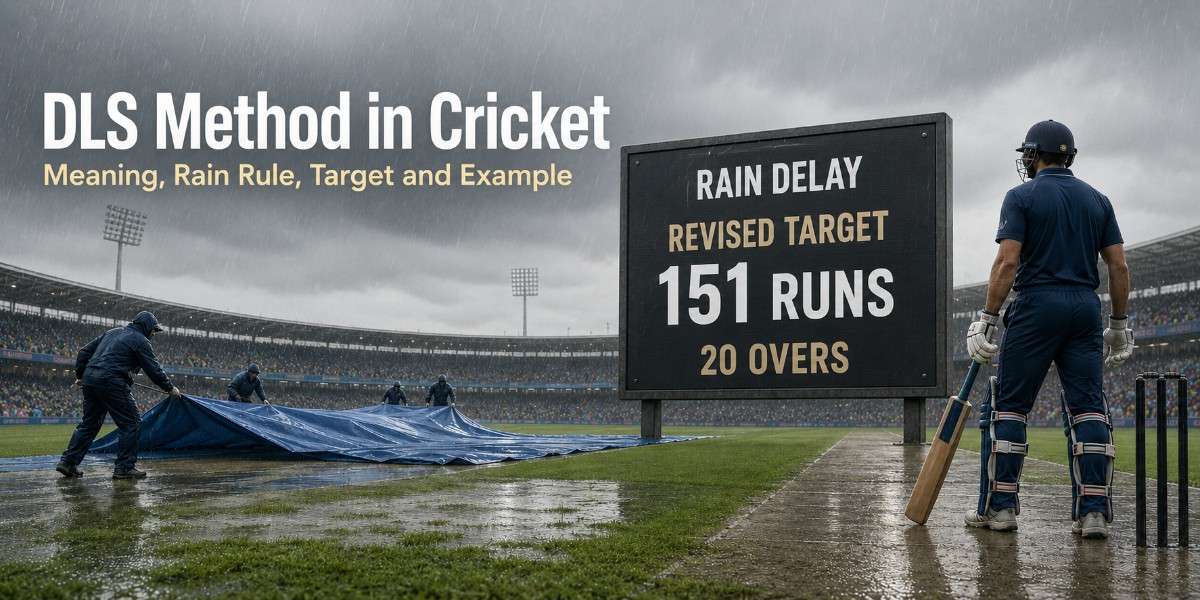
Rain can ruin a cricket match in many ways. A team may bat for fifty overs, then the chasing side may get only thirty-five. Sometimes rain cuts the first innings. Sometimes it arrives when the chase is halfway through. The DLS method in cricket exists for such matches.
The method gives a revised target in limited-overs cricket when play loses time. It does not cut the target by plain run rate. It looks at overs and wickets together, because both decide how much batting power a team still has.
DLS Method Meaning in Simple Terms
The DLS method in cricket means Duckworth Lewis Stern method. It is used in ODIs and T20 matches when interruptions reduce available overs.
The idea is simple. A batting side has two main resources:
- Balls left to face
- Wickets left in hand
A team with eight wickets left can attack differently from a team with two wickets left. A team with twenty overs left has a different chance from a team with seven overs left. The DLS system reads both parts before setting a revised target.
Why Normal Run Rate Does Not Work?
A basic run-rate calculation can look fair at first, but cricket rarely works that way. Imagine a team needs 100 runs from 20 overs with nine wickets left. Now imagine another team needs 100 from 20 overs with two wickets left. Both need the same runs, but the match situation is completely different.
The Duckworth Lewis Stern method was built to avoid that unfair reading. It gives value to wickets because wickets decide how freely a team can attack.
A chasing side with wickets in hand has room for risk. A side that has lost many wickets must play with caution. DLS reads that difference before changing the target.
When the DLS Rule Is Used?
The rain rule in cricket comes into play when a limited-overs match cannot continue under the original overs.
DLS may be used when:
- Rain stops play during the first innings
- Rain cuts the second innings short
- Bad light reduces the match
- Overs are removed after play has started
- A chase cannot be completed due to weather
Officials use the approved calculation system. Players are then told the revised target or the par score.
How the Target Changes After Rain?
The DLS target score depends on which team lost batting resources. If the chasing team loses overs, the target usually comes down. If the team batting first had less time and the chasing side gets better conditions, the target can be adjusted upward.
The calculation reads the match through these checks:
- How many overs did the first team get?
- How many wickets did the first team lose?
- How many overs will the second team get?
- How many wickets has the second team lost?
- How much batting resource remains after the break?
The final number comes from that comparison. It is not a rough guess from the scoreboard.
A Simple DLS Method Example
A DLS method example makes the idea easier.
Suppose Team A scores 260 in 50 overs. Team B starts the chase and reaches 120/2 after 25 overs. Rain arrives, and the chase is reduced to 40 overs.
Team B has already used 25 overs. It now has 15 overs left and eight wickets in hand. The revised target may become something around the 220 to 230 range, depending on the official resource table.
Now change one detail. If Team B was 120/7 instead of 120/2, the target would not drop in the same way. Seven wickets down means the chasing side has already lost a large part of its batting resource.
This is the part many fans miss. DLS does not read only rain. It reads damage too.
Par Score During a Rain Threat
The DLS par score is the number a chasing team must have at a certain point to be level under the method. If play stops and cannot restart, the par score can decide the match result.
If the batting side is ahead of the par score, it can win. If it is behind, it can lose. If scores are level with the par score, the match result follows the competition rules.
Captains watch this number closely when clouds gather. A batting side may take a risk before rain arrives. A bowling side may push for a wicket because one wicket can change the par position quickly.
How Wickets Affect DLS?
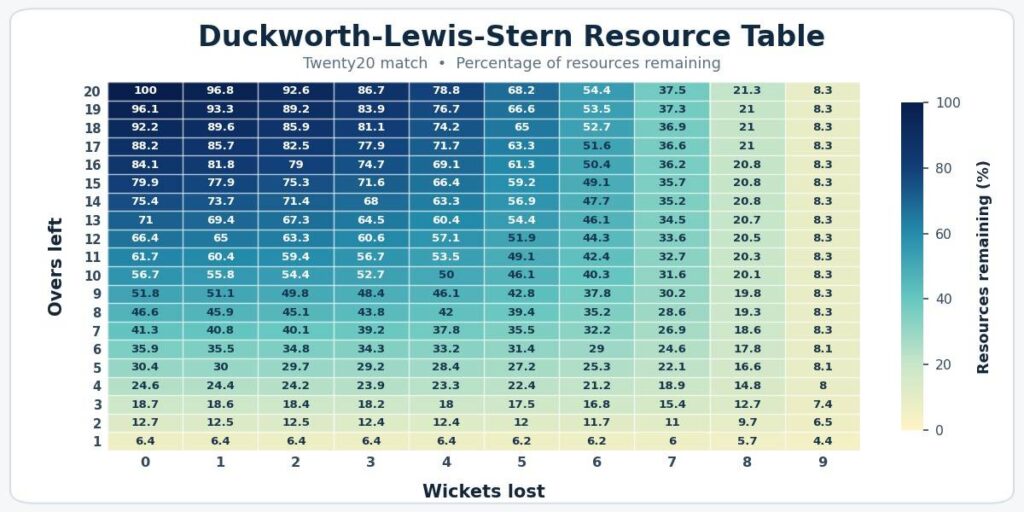
Wickets are central to the DLS method calculation. Fans sometimes expect the revised target to fall sharply after rain, then feel surprised when it does not. Wickets usually explain the difference.
Here is the match logic in simple terms:
| Situation | What DLS Reads |
| Many overs left and many wickets left | Strong batting position |
| Many overs left and few wickets left | Risky batting position |
| Few overs left and many wickets left | Short but powerful chase |
| Few overs left and few wickets left | Limited scoring chance |
A team with many wickets left can chase harder. A team with few wickets left has less freedom. DLS tries to measure that difference.
DLS in ODI and T20 Cricket
The DLS method in ODI cricket has wider room because a full innings has fifty overs. A rain break can still leave enough time for a meaningful chase if minimum-over rules are met.
The DLS method in T20 cricket can feel sharper. A T20 innings has only twenty overs, which means every lost over carries higher value. A three-over loss in T20 can change a match heavily.
This is why T20 DLS targets can look sudden. The shorter the match, the larger each over feels.
Why Fans Often Disagree With DLS?
DLS can frustrate fans because the number does not always match instinct. A viewer may think a team deserves a much lower target after rain. The official target may look tougher because wickets have already fallen.
Fans usually get confused for five reasons:
- They compare DLS with simple run rate.
- They forget wickets carry resource value.
- They miss the timing of the rain break.
- They do not see the official resource table.
- They judge the target from emotion during a close match.
The system is not perfect for every viewer, but it is far better than old rain rules that ignored match position.
Target Score and Par Score Are Different
The target score is the number needed to win. The par score is the number needed to be level at a stoppage point.
| Term | Meaning |
| Target score | Runs needed to win |
| Par score | Runs needed to be level during interruption |
| Ahead of par | Chasing team is ahead on DLS |
| Behind par | Chasing team is behind on DLS |
This difference becomes important during uncertain weather. A chasing team may be far from the final target, yet still win if rain stops play and it is ahead of par.
How Teams Change Plans Under DLS?
DLS can change a match before rain actually stops play. Batters, bowlers, and captains often adjust once dark clouds appear.
Batting teams may:
- Push harder before the next shower.
- Protect wickets when the par score is close.
- Promote a hitter after overs are reduced.
- Avoid falling behind the par number.
Bowling teams may:
- Bring strike bowlers back earlier.
- Attack the stumps for wickets.
- Protect the boundary if the batting side leads.
- Slow the scoring rate while chasing dismissals.
The method adds pressure because every over and every wicket can change the revised picture.
Summing Up
The DLS method in cricket helps limited-overs matches reach a fair result after rain or another interruption. It works by reading overs and wickets together. Plain run rate cannot do that properly.
The system may look confusing during a live match, but the cricket idea is easy. A team’s chance depends on how many balls it has left and how many wickets it still owns. DLS tries to turn that situation into a fair revised target.
FAQs
Who invented the DLS method?
Frank Duckworth and Tony Lewis created the original method after older rain rules produced unfair results. Steven Stern later updated the model, which led to the Duckworth Lewis Stern name.
Why is DLS used instead of average run rate?
Average run rate ignores wickets. DLS reads wickets and overs together, which gives a better picture of batting strength after rain changes the match length.
Can DLS increase the target after rain?
DLS can increase the target in some first-innings interruption cases. This happens when the chasing team is judged to have better batting resources than the side that batted first.
What happens if a team is level with the par score?
A team level with the par score has matched the required position at that moment. The final result then depends on the playing conditions and competition rules.
Is DLS used in domestic cricket?
DLS is used in many professional domestic limited-overs tournaments. Local competitions may use simpler systems when approved software, trained scorers, or full playing-condition support is unavailable.